Showing posts with label Native American. Show all posts

Tuesday, November 24, 2015

THANKFUL FOR AMERICA'S OPEN SPACES - An "Eyes Wide Open" Finish of MESA VERDE NATIONAL PARK

A final trek (FINALLY - yes, life gets in the way of blogs sometimes) through THE largest cliff dwelling in North America, which sits in Mesa Verde National Park.  The park is nearing their snowy season now, if not already into it.  Living in the desert SW tends to skew my view of the weather in the rest of the country.  The park is always open, but access to some of the areas is limited during the winter months.
December 18th will mark the 127th year since Richard Weatherill and Charlie Mason, ranchers in the SW corner of Colorado, stumbled upon these magnificent ruins.  Riding atop this mesa, searching for stray cattle during a blizzard, they were met by an astonishing sight across the canyon pictured... 
Three stories high, a magnificent stone city was hidden under a massive rock overhang.  The cattle search was quickly abandoned while the men climbed down, and then up, to explore their discovery for several hours. 
This is Cliff Palace - 150 rooms, 23 kivas and, speculated, home to over a hundred people, it is thought that Cliff Palace was probably a social and "administrative" site of pretty great ceremonial importance in its heyday.  The centerpiece of Mesa Verde, it is one of the finest examples of late prehistoric cliff dwellings in the American Southwest.  Much restoration has been done over the years to preserve it, this is one of the ticketed/guided tours within the park. 
Much controversy surrounds the legacy of Wetherill and Mason, and little credit seems to be given (depending on the story teller) the men in the actual discovery of Cliff Palace.  In the years following their discovery, Wetherill collected thousands of artifacts from this and other area ruins.  However, most all of Wetherill's artifacts ended up in museums, where they could be studied by professional archaeologists and viewed by the public...and MORE sadly, squirreled away in huge, dark storerooms WITHIN these museums, not to be seen by anyone in the public, since acquisition.

The same cannot be said of countless other priceless artifacts stolen by visitors over the years, which ended up in private collections.  To protect the site from further looting and degradation, Congress named Mesa Verde a National Park in 1906.
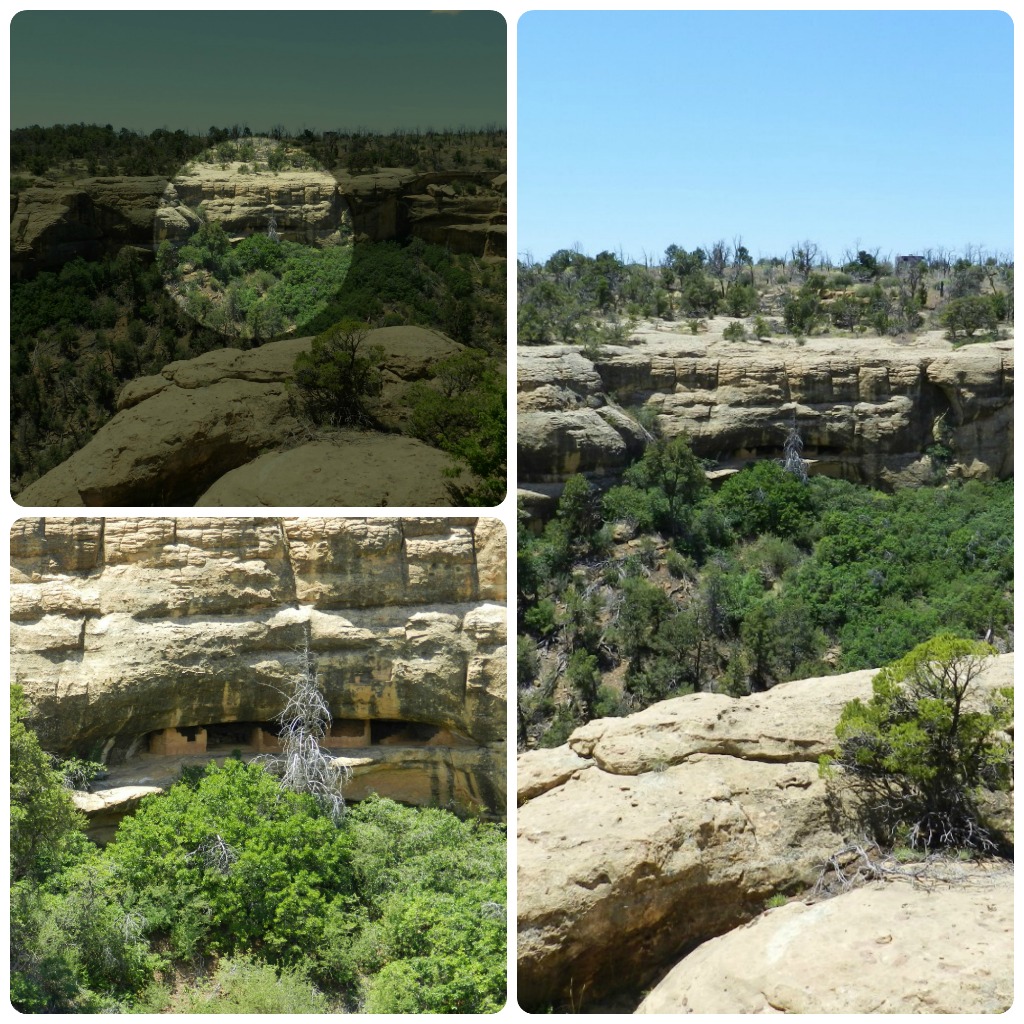
These canyon walls are literally dotted with ruin after ruin, if you keep your eyes wide open, and take the time to look.  Some are nothing more than small storage spaces, or single family dwellings...some a little larger...you just have to look.  This was in the canyon walls opposite the massive dwelling, and sitting under the mesa top where Cliff Palace was originally spotted from.
 Today, this Park protects some 5,000 known archaeological sites, which includes 600 cliff dwellings.
The House of Many Windows, in the same general vicinity.  These, and the "afore-blogged" dwellings are all on the Chapin Mesa, and open year-round, whether viewing from a distance, or taking an up-close and personal tour.  Go in with eyes wide open - you never know where you might spot something a little more spectacular than just beautiful scenery.
On the opposite side of the park, but all within a little less than 20 miles by car, sits Wetherill Mesa - home to beautiful tourist lodging, and even more ancient treasures.  This side of the Park is only open from May to September, weather permitting.  We ran into a hell of a thunderstorm that day, that stopped us from hiking the last ruin, due to waiting out the rain and hitting there at closing time.  If you go, plan ahead and leave yourself plenty of time.  It was actually a blessing in disguise for me to have missed it, as my cowboy boots had just about had it by this tree. 
 Like I said, they're everywhere....
EVERYWHERE!  One of the greatest gifts we have as Americans is the freedom to travel as we please. To get out and discover this great land of ours - the history and treasures it holds - and to LEARN - even the women!  Thankful, as I look at these photos, for a lifetime of being allowed to soak up everything I can!
A parting shot of the ruins of Hemenway House - yep, eyes wide open (go back up a few photos and look, but they are in the center of the mesa, under the large shaded overhang).  Want to explore for yourself...

Happy Thanksgiving from my house to yours...may it be SAFE, happy, and spent with someone you love!

Tuesday, September 1, 2015

GENERATIONS - KEEPING OLD TRADITIONS ALIVE on "Travel Tuesday"

I do a few weeks of traveling through Native American lands every summer, in New Mexico and Arizona.  These states are dotted with what remains as a reminder of some of the worst travesties inflicted upon a people by the greed of the United States government - the Indian Reservations of the American Southwest.  I have a weird relative that halfway believed, right up until a few years ago, that Indians lived in tepees, still.  Those would probably be more comfortable than some of the hard truths of the reservations of today, and those that choose to remain - but that's a post/photos for another day.  Today is for old traditions being passed, thankfully, to a younger generation - at least in one family, but I'm hoping this rings true for quite a few.
We spent a day at the Loveland Invitational Fine Arts Festival, outside of Denver, this past month. The arts committee had brought in the Tony Duncan family, from Mesa, Arizona, to entertain during a short period of the first morning.  Tony, and his three beautiful children, ranging in age from 6 to 2 - not only is dad (with Apache/Arikara/Hidasta tribal nation roots) an accomplished Native American Flute player, he is also a 5-time World Champion Hoop Dancer.  We were told that Mom, Violet Duncan (Plains Cree and Taino), an author and former Miss Indian World, was the one responsible for most of the beadwork seen that day.
She's already been a Tiny Tot Princess, several times over!  These are not everyday clothes, but typically reserved for ceremonial dances, such as the big Pow Wows (the family had spent the summer apart, attending events in Canada and the States).  The dress worn here is referred to as a Jingle Dress.  Originating with the Ojibwa tribes, and spreading through the Sioux nation and Plains tribes later, the tin cones on the dresses were originally fashioned from tobacco can lids.  The sound is enchanting.
Mom's brother hailed from Canada, and performed the fast-paced Men's Fancy Dance, based loosely on the War Dance.  During the 20's and 30's, many of the Native American dances were outlawed by the American and Canadian governments.  Many dances went underground to avoid detection, and eventually dances were reworked as to be danced legally in public.
The Kiowas and Comanches created new styles of dance regalia in the1930s, that included long-johns with bells attached to the knees, arm and back bustles, beadwork harnesses, feathers, streamers of horsehair, and a large porcupine hair roach atop the head.  This was all eventually incorporated into the Fancy Dance.
The Grass Dance was another Northern Plains Indian style of dance.  The dance wear generally has few feathers, as compared with the Fancy Dancers, but is plentiful with swaying fringes of yarn and ribbons.  Not as fast as the Fancy Dance, this is still "taxing" in its movements.  We were told this dancer was of the Arikara nation - gorgeous regalia including another beautiful roach atop his head, colorful applique work, and what appeared to be porcupine quill work on the dance moccasins. 
As someone who "dabbles" in sewing and the occasional beaded piece of jewelry, I can tell you the sheer amount of skill and time in these handmade pieces was mind boggling!  The breastplate on the upper right was all hand beaded by the dancer's sister (Violet), and I had to smile at the little guy's beaded Ninja Turtle medallion - infusing new with old.
Dad (Mom can be seen in the background) and the Hoop Dance - a storytelling of sorts, with the use of between 1 to 30 hoops, at any given time.  During the dance, shapes are formed for storytelling - eagle, snake, coyote, to name a few,  Fast-paced, with the dancer moving through or using the hoops as an extension of his body - Tony Duncan holds 5 World Championships, and is now passing his art down to his little ones.
Another beautiful example of Violet's mind-blowing beadwork craftsmanship, and Tony's prowess with the hoops.
Truly a modern-day family affair of time-worn traditions, most thankfully!
Which brings me to the youngest of the troupe - Manaya, Naiche, and little Nitanis.  Words cannot express the love on this stage - proud of a heritage, and carrying on the old ways through a new generation.  The oldest daughter poised beyond belief at 6 years old - performing dances completely by herself, as well as with her younger siblings.
It saddens me to see many of the old ways and traditions (crafting and ceremonial events included), being pushed aside due to progress and time, and a desire for moving ahead with "the new"...
THIS renewed a hope that all is not lost - carried on through the eyes and hearts of these little ones. Also, a pretty cool day at the park with Dad - I could never really master a Hula Hoop, and these little ones have it going on, and then some!  Carry on, Duncan Family - you're doing it COMPLETELY right!